Historical Research and Exhibition Interpretation | American Jewish Historical Society | 2005–2006
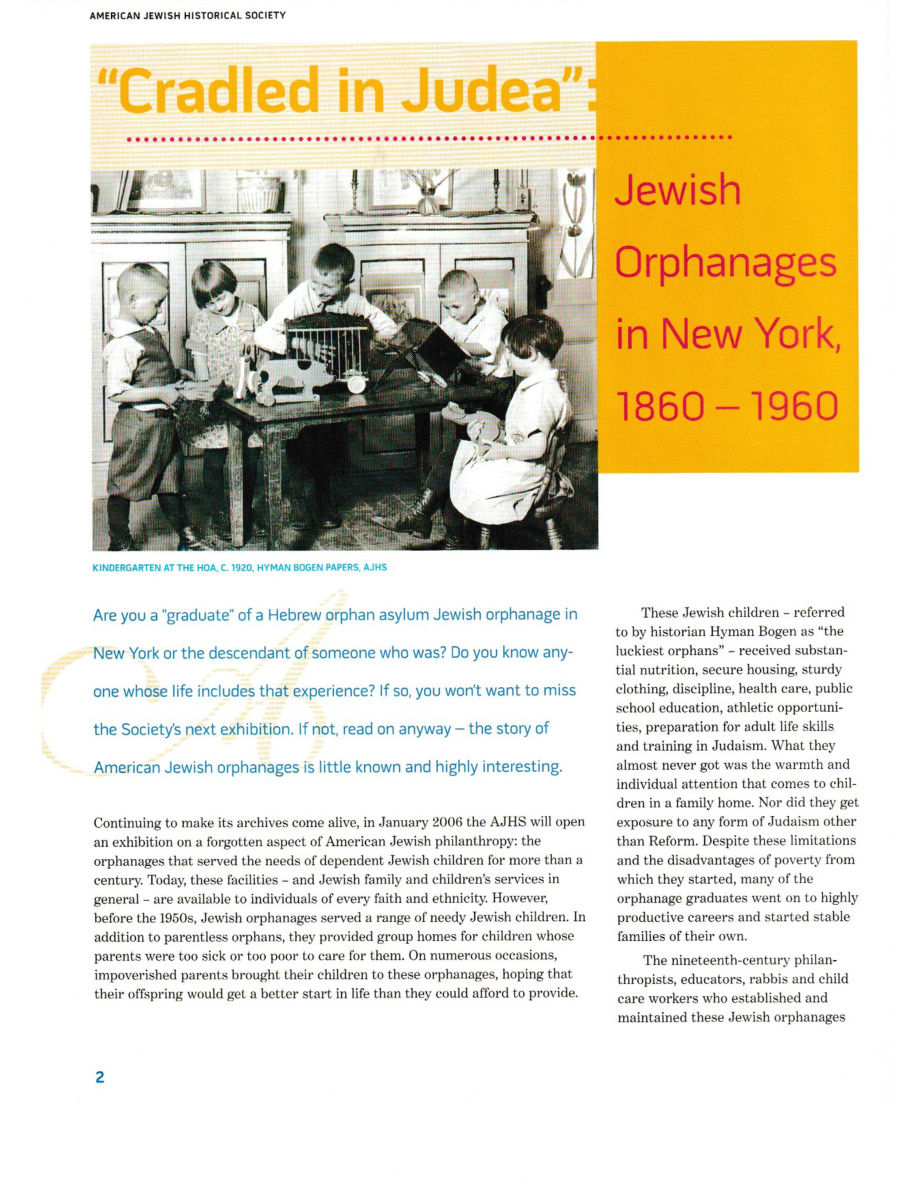
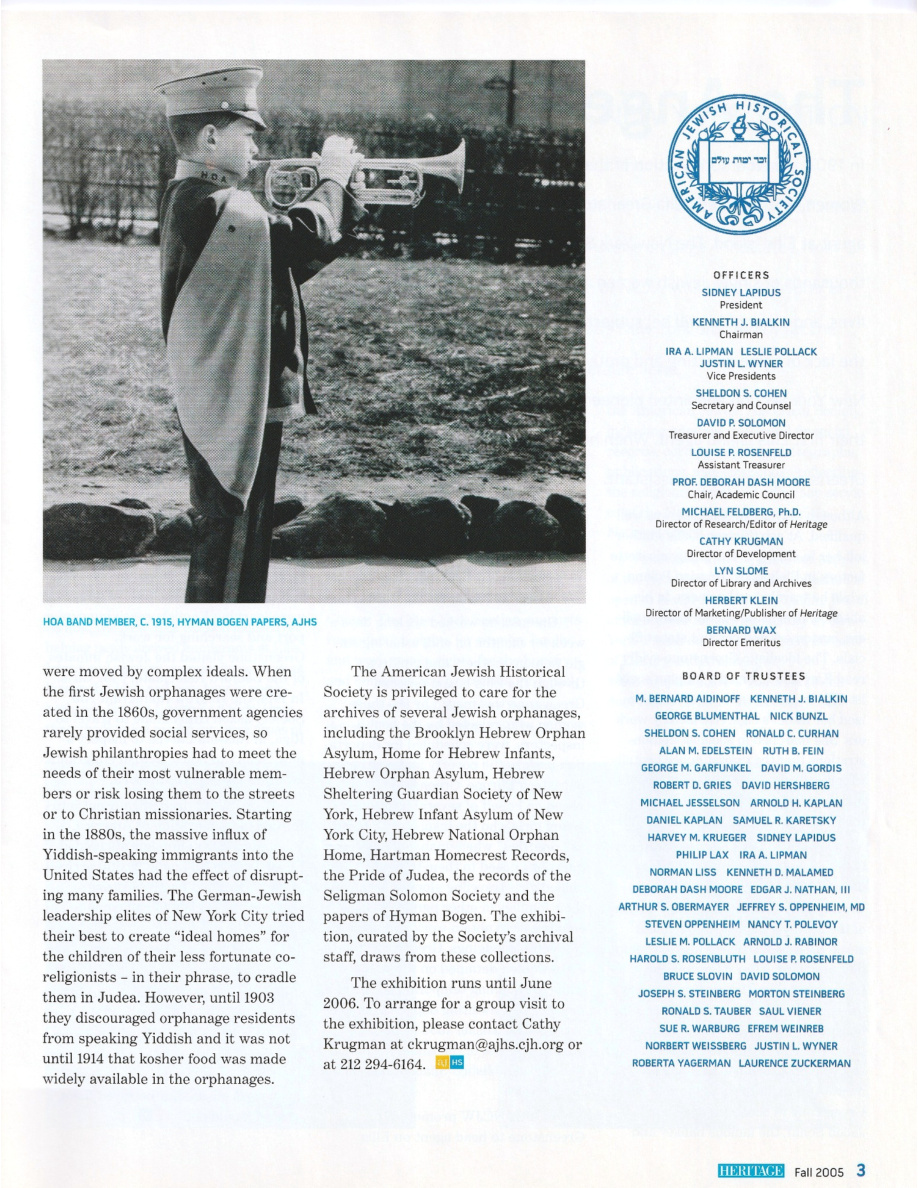
Conducted historical research and developed interpretive text for Cradled in Judea, an exhibition examining a century of Jewish orphanages in New York City.
Drawing on historical records and institutional histories, I developed exhibition narratives exploring children's experiences, the evolution of institutional care, and changing approaches to child welfare. My contributions included a historical timeline and interpretive writing on foster care and adoption, cottage-style institutions, and the Home for Hebrew Infants.
The project required translating complex historical research into accessible, engaging narratives for museum visitors.
Selected Exhibition Text
The Growth of Foster Care and Adoption
From the beginning it was clear that orphanages could never house and nurture all children in need. Despite massive expansion projects, lack of space was a persistent problem.
At first administrators sent only a few children to foster homes. Many believed orphanages offered better supervision and a superior environment, and they were eager to keep their institutions filled to collect the maximum allowance of state funds.
Yet orphanages faced increasing criticism for stifling children’s personalities and leaving them permanently “institutionalized.” Administrators gradually expanded their foster care programs, until the only ones left within the orphanage were those with mental, emotional, and physical disabilities.
Many children thrived in family care. Others resented the frequent transfers from home to home, always feeling like unwelcome guests. Over time casework became more professionalized, and the supervision and training of foster parents improved. Parents were invited to visit foster homes and stay involved in their children’s lives.
Since the vast majority of Jewish dependent children were not full orphans, few were available for adoption. But together fostering and adoption eventually eclipsed costly and impersonal institutional care, even for infants and special needs children. One by one, Jewish orphanages closed their doors or merged with sister agencies. By 1960, the golden age of the orphanage had come to a close.
The Cottage System
One Jewish orphanage, HSGS, decided to develop an alternative to the grand, impersonal orphanage. Pleasantville was the country’s first cottage care system, designed to simulate normal home life with smaller living groups, a more domestic environment, and trained “cottage mothers.” Once underway, Pleasantville became a model community, with state-of-the-art educational and recreational facilities and programs designed to integrate children into the larger community and keep them in frequent contact with their families.
As foster care came to dominate work with dependent children, normal youngsters were transferred to family homes, and Pleasantville amended its mission to serve only maladjusted children who needed psychiatric care.
A Place for Babies
Noticeably lacking in the 19th century was an institution for homeless Jewish infants. To avoid having Jewish babies placed in the city’s Catholic or Protestant infant asylums, the Hebrew Infant Asylum, later renamed the Home for Hebrew Infants, opened in the Bronx in 1895. The asylum, which began with only five tiny residents, quickly expanded to larger facilities housing hundreds of babies.
In 1910, the administrators opened a new receiving hospital equipped with individual glass cubicles to quarantine all new arrivals and stem the spread of contagious disease. In addition the institution boasted sunlit nurseries, breezy sleeping porches, modern medical facilities and laboratories, and even a Training School for Infant Nurses.
In time, however, child development experts cast doubt on the benefits of congregate care for infants, alleging that former residents of HHI performed more poorly in school than children who had not been institutionalized at such a young age. Individual attention and affection, it seemed, were just as important as scientific facilities and expert staff. By the end of the decade, administrators had begun a tentative exploration of infant foster care that would gradually eliminate the need for the institution altogether.